Window Terminology 101: Common Terms You’ll Hear During a Replacement Window Consultation
Have you ever sat through a window consultation and found yourself nodding along to words you didn’t quite understand? You’re not alone! Window terminology is full of industry shorthand that most homeowners never encounter until they’re shopping for replacement windows.
We’d rather you walk into that conversation informed than guessing. Below is a plain-English glossary of the window terms you’re most likely to hear. Organized alphabetically so you can jump straight to the word you need.
General Window Terms
Air Leakage Unwanted air movement into or out of a home through gaps around a window or door, not through the window itself, but around it, where it meets the frame or wall. Lower air leakage generally means a tighter, more energy-efficient window.
Airspace The gap created between two or more layers of glass in a dual- or triple-glazed window (see “Dual Glazing”). Ideally, this space is filled with a low-conductivity gas or near-vacuum, which slows heat transfer and improves insulation.
Building Envelope The complete barrier between a home’s interior and the outdoors, the floor, walls, ceiling, and every window and door opening. The space inside that envelope is called the conditioned interior space.
Condensation Moisture or fogging that appears on window glass. Occasional condensation on the interior glass surface is often just humidity; condensation between panes of glass usually signals a seal failure and may mean it’s time to consider replacement.
Dividers Also called muntins, grilles, or grids, the strips that visually divide a window’s glass into smaller sections.
Fenestration An umbrella term for any opening in a building’s exterior wall, including windows and doors, that allows light, air, or people to pass through.
Fixed Window A window that does not open, such as a picture window. Fixed windows are often used where maximum light and view matter more than ventilation.
Glazing A single pane of window glass. “Single glazing” is one pane; “dual glazing” is two panes with airspace in between; “triple glazing” adds a third pane for even greater insulation.
Operable Describes a window designed to open and close. Its opposite is “non-operable” (a fixed window) note that “inoperable” is a medical term, not a window term, even though it sounds similar.
Sash The framed section of a window that holds the glazing in place. A double-hung window has two sashes (upper and lower); a casement window typically has one.
Weatherstrip Also called weather seal, a flexible strip installed around a window or door to reduce air leakage and prevent water penetration.
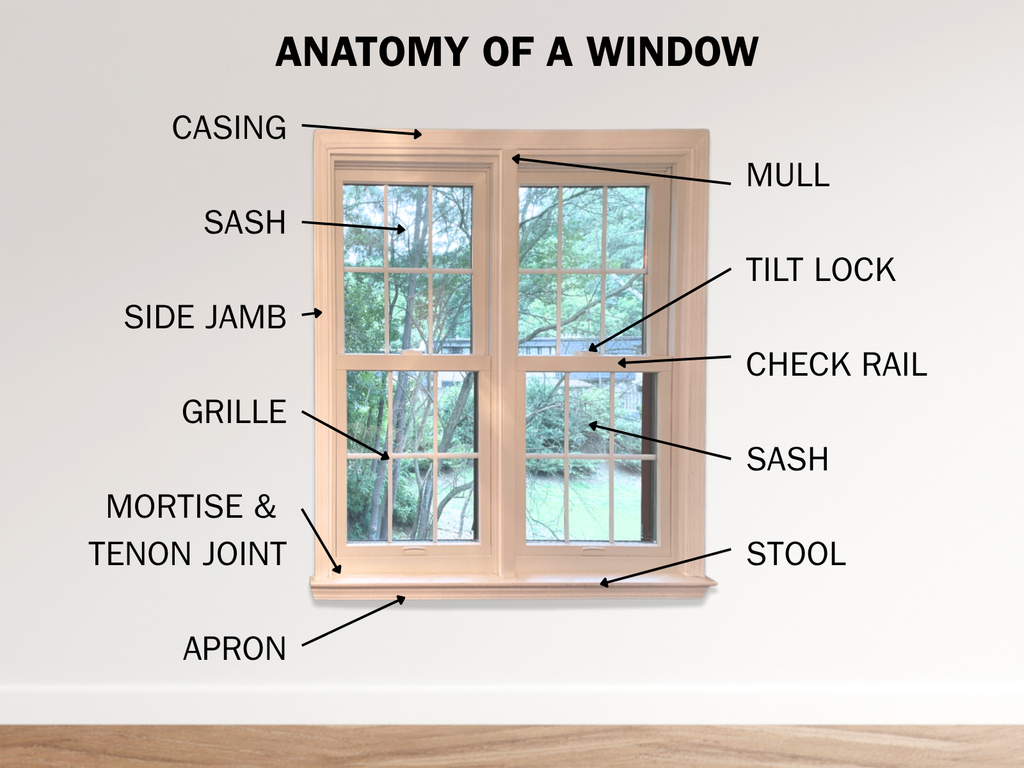
What are the parts of a window?
- Frame is the structure surrounding and supporting the window.
- Head is the top horizontal part of the frame.
- Jambs is the vertical sides of the frame.
- Sill or Stool is the bottom horizontal part, often sloped to shed water.
- Sash is the movable or fixed framework that holds the glass.
- Glass or Glazing are the transparent panes of glass.
- Muntins or Grilles — Narrow strips that divide the glass visually or physically into smaller sections.
- Casing or Trim is the decorative material covering the joint between the window frame and wall.
- Weatherstripping is a material that seals gaps to reduce drafts and water intrusion.
- Hardware are the locks, handles, hinges, cranks, or tracks used to secure or operate the window.
For a double-hung window, there are usually two sashes, an upper sash and a lower sash, that slide vertically.
Here’s a helpful graphic of the anatomy of a window.
Energy Efficiency Terms Worth Knowing
These terms show up constantly in window comparisons and are directly tied to how much a window will cost you to live with over time. These terms are worth understanding before you compare quotes.
U-Factor Measures how well a window prevents heat from escaping. The lower the U-Factor, the better the window is at keeping conditioned air inside your home.
Solar Heat Gain Coefficient (SHGC) Measures how much solar radiation passes through a window and turns into heat inside your home. A lower SHGC means less solar heat gain, generally desirable in warmer climates or south-facing windows.
Low-E Glass Short for “low-emissivity”, a microscopically thin, virtually invisible coating applied to glass that reflects heat while still letting light through, improving energy efficiency without darkening the room.
Argon Gas An inert, non-toxic gas often used to fill the airspace between panes in dual- or triple-glazed windows. It’s denser than air, which slows heat transfer and improves insulation compared to an air-filled airspace.
R-Value A measure of a material’s resistance to heat flow. Unlike U-Factor, which is standard for comparing whole windows, R-value is more commonly used for insulation materials, though it’s occasionally referenced in window specs as well.
ENERGY STAR A certification from the U.S. Environmental Protection Agency indicating a window meets specific energy-efficiency criteria for its climate zone. Not all energy-efficient windows carry this label, but it’s a helpful benchmark when comparing options.
Bring This List With You
Whether you’re comparing quotes or sitting down for a replacement window consultation, understanding these terms puts you in a better position to ask the right questions and compare options on equal footing. If a term comes up that isn’t on this list, don’t hesitate to ask, a good consultation should leave you more informed, not more confused.